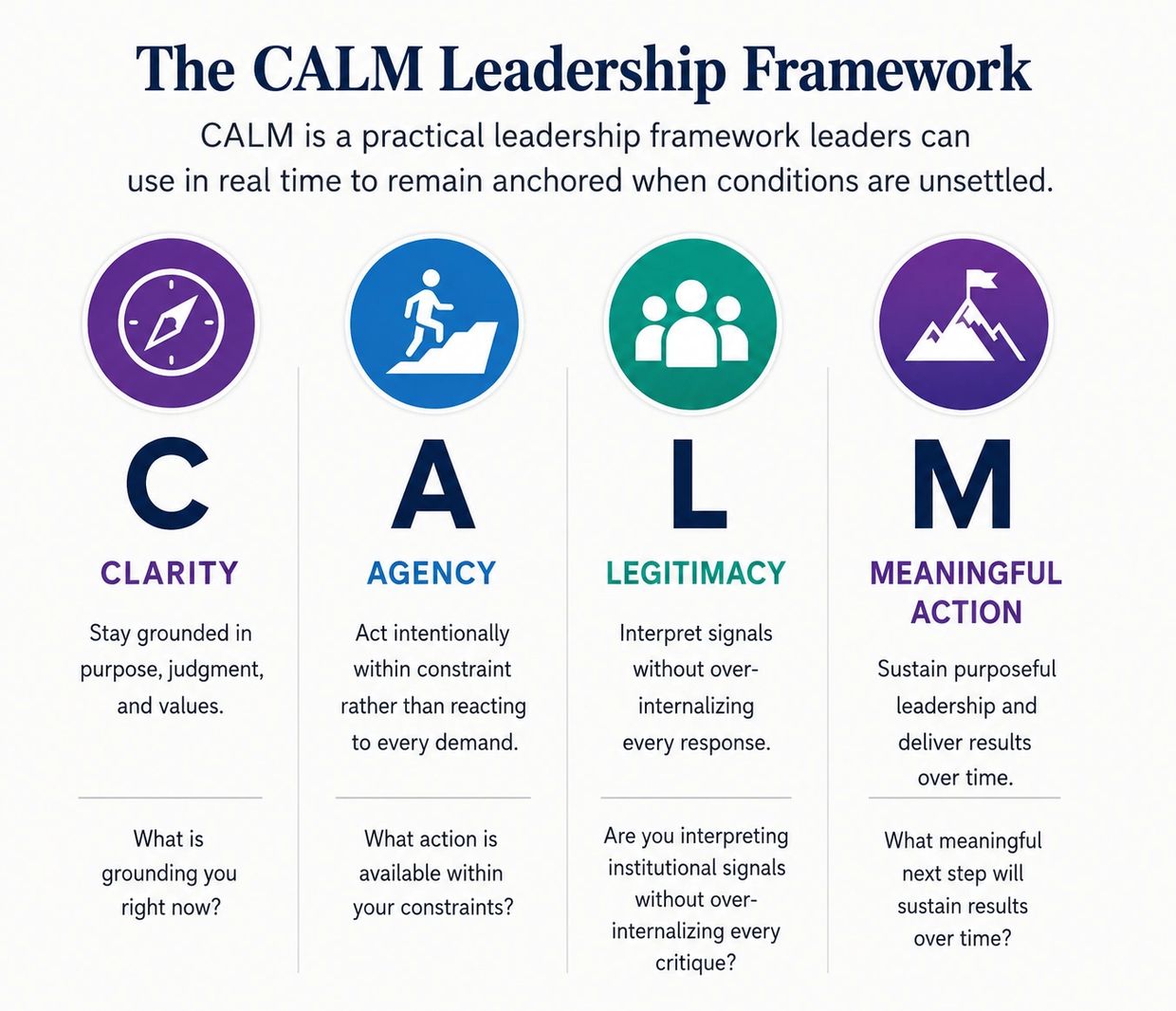

CALM is a reflective leadership framework that helps leaders remain grounded, intentional, and effective in complex environments.
Rather than focusing solely on performance or resilience, CALM strengthens the internal capacities leaders need to sustain clarity, agency, legitimacy, and meaningful action over time.
Leaders use CALM to pause, reflect, and act in alignment with purpose, particularly when conditions are complex and signals are uneven.
See CALM in Practice (for offerings) | Read Anchored Insights (for essays)

Today’s leaders are expected to navigate complex environments while remaining effective, adaptive, and grounded in their judgment. Competing demands, institutional scrutiny, shifting expectations, and constant evaluation can challenge clarity, perspective, and sustained leadership effectiveness over time.
Traditional leadership approaches often emphasize performance, resilience, and execution. CALM adds a deeper layer by helping leaders pause, interpret conditions, and choose their next action with greater clarity and steadiness. It is especially useful in settings where leaders must navigate complexity without losing coherence, purpose, or credibility.
For example, federal agencies may be navigating shifting mandates, oversight, and public accountability, while nonprofit organizations may be balancing mission commitments, funding constraints, board expectations, and community trust. CALM gives leaders a practical way to stay anchored while making decisions in conditions that are complex, visible, and often uneven.
Beneath the practical CALM framework is a deeper architecture for leaders, scholars, coaches, and educators who use CALM in coursework, leadership development, coaching, or research.
CALM draws from research on leadership identity, self-efficacy, legitimacy, and adaptive regulation to explain what often happens beneath the surface as leaders navigate complexity.
This deeper architecture helps leaders understand why they may react as they do in complex environments, how institutional signals shape confidence and judgment, and how they can respond with greater clarity, steadiness, and purpose.

What the Deeper Architecture Helps Leaders See
A Scholar-Practitioner Foundation
CALM is grounded in the intersection of executive leadership experience, applied scholarship, and leadership education.
The framework reflects Dr. Patrina M. Clark’s experience as a former federal Senior Executive, consultant, scholar-practitioner, and leadership educator. It is informed by decades of work in public service, governance, organizational leadership, and leadership development, as well as research on how leaders sustain identity, confidence, credibility, and effective action in complex environments.
For scholars and educators, CALM offers a conceptual bridge between leadership theory and leadership practice. For coaches and consultants, it provides a practical structure for helping leaders examine how they are interpreting conditions, exercising agency, and sustaining purpose-aligned action over time.
For practitioners, CALM helps leaders pause, interpret, and act with greater clarity when conditions are complex, feedback is uneven, and expectations are competing.
Leadership in complex environments requires more than expertise, visibility, or the ability to perform under pressure.
It requires the capacity to stay grounded when conditions shift, expectations compete, and feedback is uneven. CALM helps leaders strengthen that capacity by offering a practical way to pause, interpret, and act with purpose.
The framework supports leaders as they navigate scrutiny, ambiguity, and institutional complexity without losing clarity, perspective, or direction.
CALM gives leaders a shared language and practice for staying anchored as conditions change and institutional signals remain uneven.
Dr. Clark uses this framework in executive coaching, leadership cohorts, and custom workshops for public and mission-driven organizations.